

Red flesh
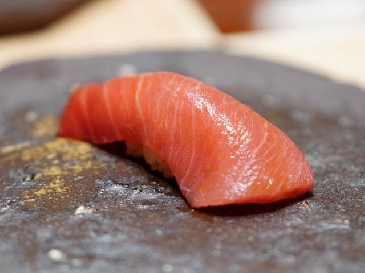

Pacific bluefin tuna (Taiheiyou maguro)
【Nigiri sushi: Akami】
In Japan, the term “hon-maguro” generally refers to two species: the Pacific bluefin tuna and the Atlantic bluefin tuna. In most cases, however, it specifically refers to the Pacific bluefin tuna.
The Pacific bluefin tuna primarily spawns in waters extending from the seas around Okinawa and the Nansei Islands to the waters east of Taiwan. In recent years, reports have suggested spawning activity not only in the southwestern part of the Japan Sea but also off the coast of Sanriku, attracting attention to the area as a potential new spawning ground. The spawning season mainly occurs from around May to July, differing from albacore and yellowfin tuna, which spawn year-round.
It is believed that Pacific bluefin tuna spawn in the waters around Okinawa, the Nansei Islands, and east of Taiwan because the hatched larvae can be easily carried by ocean currents such as the Kuroshio Current to northern waters where food is abundant. The larvae grow in waters near Japan, reaching a body length of about 50 cm and a weight of about 3 kg approximately one year after hatching. Until this stage, they are thought to engage in seasonal migration, moving north along the Japanese coast during summer and south during winter.
As they continue to grow, some individuals undertake a large clockwise migration around the northwestern Pacific, and some even cross the Pacific Ocean, traveling from waters off California to waters off Mexico. Locally, the period from May to October is known as the sport fishing season. However, spawning in these waters has not yet been confirmed. Pacific bluefin tuna are known to grow while feeding during their north–south migrations, and once they reach maturity, they cross the Pacific again to return to spawning grounds in waters near Japan. This strong tendency to return to their spawning grounds is one of the defining characteristics of the Pacific bluefin tuna.
The Pacific bluefin tuna is a highly predatory fish that feeds on a variety of organisms depending on its growth stage and habitat. In waters near Japan, its main prey consists of sardines, flying fish, Pacific saury, squid, and small skipjack. Among sushi chefs and fish brokers, it is often said, based on experience, that “the flavor and aroma of the fat, as well as the texture of the flesh, change depending on what the tuna ate while growing.” For example, some chefs believe that individuals that consumed large amounts of sardines develop a sweeter fat profile, while those that fed heavily on flying fish tend to have firmer flesh and a cleaner aroma. It is also sometimes said that tuna that consumed large amounts of squid possess a stronger umami flavor.
Atlantic bluefin tuna, meanwhile, is a separate species found in the Atlantic Ocean and is genetically distinct from the Pacific bluefin tuna. It is believed to feed heavily on fatty fish such as mackerel and herring and is often described as having a rich, full-bodied flavor. However, for the average person, distinguishing the two species based on appearance alone is extremely difficult.
【Related contents】
Types of fishing method
Main production area
Aomori Hokkaido Nagasaki
Season
Autumn – Winter