

Silver-skinned
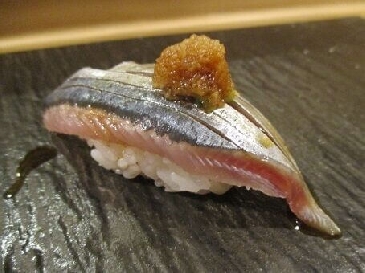

Pacific saury (Sanma)
【Nigiri sushi: Hikarimono】
What is Pacific saury (Sanma)?
Pacific saury is relatively shallow-water fish that live at approximately 20 m below the surface and migrate in schools. However, sometimes they may jump over the surface of the sea, much like Flying fish, when escaping from natural enemies such as tuna. They live in water temperatures of 7 to 24℃. More specifically, this fish prefers water temperatures between 10 to 18℃, and it lives on a diet of zooplankton, krill, fish roe, etc. Its main spawning season is winter, but it may breed during other seasons as well. However, as has become a common theme, Pacific saury catch has been sluggish in Japan in recent years. Presumably due to rising seawater temperatures and increased activity in foreign fishing ships, there is a need for further efforts to enforce international fishing controls and recovery of resources.
The females lay their eggs in algae that float on the ocean surface. They hatch and fully mature in about one year. The lifespan of this fish is two years and the large ones that exceed 30 cm are at least one year old. A characteristic of Pacific saury is that they are phototactic and are attracted by light. Saury ships use this behavior by illuminating lights that lure fish to fishing spots and driving the schools they attract into nets. Pacific saury fishing starts at the beginning of July. The Pacific saury hauled to the fishing ports of the eastern parts of Hokkaido are highly valued as the first of the season and have become a valued brand. Once September comes along, they migrate south for spawning grounds and are hauled to the fishing ports of Iwate or Miyagi prefectures or Choshi city in Chiba prefecture. They can be fished between July and November.
What does Sanma (Pacific saury) nigiri sushi taste like?
In the tradition of Edomae sushi, using Pacific saury as a topping for nigiri sushi was once considered unconventional. However, it has now become a staple autumn topping found in sushi restaurants throughout Japan.
The primary reason for the widespread popularity of Pacific saury nigiri is the dramatic advancement of refrigeration technology and logistics networks from the postwar period through Japan’s era of rapid economic growth. Improvements in onboard cooling technology, the widespread adoption of Styrofoam containers, and advances in refrigerated transportation and air freight made it possible to distribute highly perishable Pacific saury nationwide while preserving a level of freshness close to that of newly landed fish.
As a result, it became possible to serve Pacific saury raw or as nigiri sushi—something that had previously been difficult—and it gradually established itself as a recognized sushi topping.
Pacific saury pairs exceptionally well with vinegared rice, creating an exquisite balance between the rich umami of its fat and the gentle acidity of the rice. In particular, fresh autumn Pacific saury, prized for its high fat content, is often scored with decorative knife cuts and garnished with grated ginger and chopped green onions to enhance its flavor.
Additionally, lightly curing the fish with salt and vinegar helps moderate its richness, transforming it into a refined delicacy that can seem almost like a different fish altogether.
Furthermore, for those who are not fond of oily fish, as well as for children, lightly searing the skin is a popular preparation method. The resulting nutty aroma makes it more approachable and enjoyable.
Also called Mackerel pike or Saury or Skipper
【Temperature of vinegared rice (shari) and sushi toppings】
36℃/20~23℃
【Related contents】
What is Daikon oroshi?
Why can’t Sanma (pacific saury) be caught?
What are the important points when using ice to kill small fish?
List of Silver-skinned fish (Hikarimono)
(Revision date: June 3, 2026)
Main production area
Hokkaido Iwate Miyagi
Famous production area
Miyako Kusiro Ishinomaki Akkeshi
Season
Autumn