

White flesh
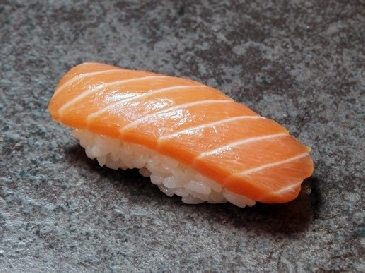
Atlantic salmon (Taiseiyousake)
【Nigiri sushi: Shiromi】
The Atlantic salmon (Salmo salar) belongs to the salmon family and the genus Salmo. The Latin name “salmo” means “salmon,” while “salar” means “to leap.” In Europe, the term “salmon” often specifically refers to the Atlantic salmon.
Because wild stocks are in critical condition, most Atlantic salmon sold at sushi restaurants and supermarkets comes from farms. Farming occurs in Norway, as well as in Canada, Russia, the UK, Chile, and Tasmania, Australia, providing fish of consistent quality to sushi restaurants. Farmed salmon are raised from artificially hatched fry on a controlled diet, making them safe to eat raw.
Although the term “Atlantic salmon” itself isn’t widely recognized in Japan, it is a staple at sushi restaurants. It is also used in dishes such as meunière, steak, sashimi, canned salmon, and smoked salmon, but it is most commonly served as “salmon” in nigiri or seared sushi. In supermarkets, it is labeled as “Norwegian salmon.”And in industry jargon, it is called“Atlan.”
Atlantic salmon (farmed) is known for its even fat distribution and melt-in-your-mouth sweetness. Its mild flavor makes it approachable even for first-time eaters. It pairs perfectly with vinegared rice and soy sauce, and lightly searing it enhances the balance between its savory aroma and the sweetness of its fat. It’s also rich in omega-3 fatty acids and high-quality protein, making it a popular choice at sushi restaurants for customers of all ages, from children to the elderly.
【Related contents】
Salmon is not used as a topping in Edo-style sushi!
Why is salmon so delicious?
What is Toro salmon?
What is Masuzushi?
Types of salmon
List of White flesh fish (Shiromi)
Main production area
Norway Canada The UK Chile Australia
Season
All year round