

White flesh
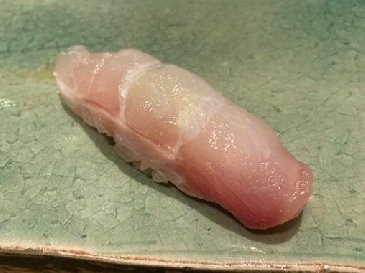

Cobia (Sugi)
【Nigiri sushi: Shiromi】
Cobia (Sugi) is a marine fish distributed in warm waters throughout the world, except for southern Japan and the eastern Pacific. It inhabits both coastal and offshore waters, typically near the surface. The species can reach a maximum body length of 150 cm.
In appearance, cobia resembles the live sharksucker (Kobanzame). The body is brown with two pale longitudinal bands in juvenile stages, which gradually fade with growth, resulting in a uniform grayish-brown coloration in adults.
Cobia is not widely known as a traditional food fish due to its limited natural distribution. In Japan, it has mainly been used as an ingredient for fish paste products. At one time, it was introduced as having a texture similar to greater amberjack (Kanpachi) and was referred to as “Kuro-kanpachi” or “Toro-kanpachi,” functioning as a substitute fish. The flesh is white, firm, and moderately fatty, and is commonly used in sashimi, salt grilling, and teriyaki.
Its culinary use extends beyond Japan. Cobia is commercially sold worldwide and is valued for its firm texture and excellent flavor. When cooked, the flesh becomes opaque and flakes easily with a fork, similar to other firm-fleshed fish such as swordfish. It can be prepared in various ways, including grilling, frying, baking, and smoking, and pairs well with a wide range of seasonings.
In Okinawa, particularly around Kouri Island, full-scale aquaculture has been successfully established. As a result, cobia—also known as Ryukyu Sugi—is increasingly being served in conveyor-belt sushi restaurants.
Cobia is regarded as a highly efficient species for aquaculture. The feed conversion ratio (FCR), which indicates the amount of feed required to increase 1 kg of body weight, is approximately 12–15 for tuna, 2.5–3 for yellowtail, and 1.2–1.5 for salmon, whereas Ryukyu Sugi ranges from 1.3–1.9. This means that while tuna requires 12–15 kg of feed to gain 1 kg, Ryukyu Sugi requires only 1.3–1.9 kg. It grows rapidly, reaching 5 kg from 200 g within one year. Due to its low feed requirement and high growth efficiency, it is considered a highly sustainable aquaculture species.
【Related contents】
List of White flesh fish (Shiromi)
Main production area
Kagoshima Nagasaki
Season
Summer