

Red flesh
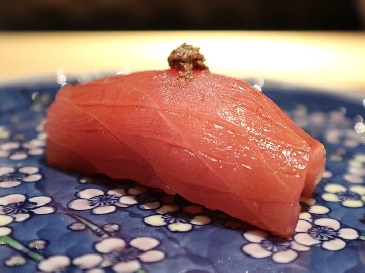

Bigeye tuna (Mebachi maguro)
【Nigiri sushi: Akami】
What is Mebachi maguro?
Mebachi maguro (Bigeye tuna) are found over a wide area in the Pacific, Indian and Atlantic Oceans at ideal temperatures of 11 to 29℃, but they don’t live in the Mediterranean Sea. The red meat of Mebachi is a dark crimson. The taste is even comparable to Kuromaguro. To be picky, it isn’t quite as rich. Also, the Otoro, the belly part, has tough white lines, which detract from the texture. Since they are caught in high volume, it’s not priced as highly as Kuromaguro. Also, Mebachi is both produced domestically in Japan and imported both frozen and refrigerated from overseas. The color of this fish also doesn’t change quickly, so it is considered ideal for takeout sushi. Incidentally, at the Toyosu market Mebachi is abbreviated to “Bachi”.
What does Mebachi maguro (Bigeye tuna) nigiri sushi taste like?
Bigeye tuna (Mebachi maguro) is widely distributed in tropical waters on both sides of the equator. Because it grows in warm waters, its flesh is typically somewhat soft and low in fat. However, in the fall, when it migrates north to the waters off the Sanriku coast in search of food, its flavor changes dramatically. Fresh mebachi fetches high prices during this season, and the juiciness of its red meat is so striking that it’s hard to believe it is the same fish as the frozen mebachi available in supermarkets year-round.
On the other hand, frozen mebachi is caught across the Indian, Pacific, and Atlantic Oceans, so quality can vary significantly depending on the fishing grounds and the freezing techniques used on each vessel. When thawed, moisture can seep out of the flesh, sometimes resulting in a watery texture. In general, the mebachi sold at conveyor-belt sushi restaurants and supermarkets is mostly frozen.
Bluefin tuna has the richest flavor among tuna species and is characterized by a subtle acidity. Bigeye tuna, on the other hand, has a milder acidity, with the sweetness and umami of its fat taking center stage. If you have the chance to try fresh mebachi in the fall, you will likely be amazed by its deliciousness, which rivals that of bluefin tuna.
Also called Albacore or Coffrey or False albacore Japanese tuna.
【Related contents】
Types of tuna
You know toro tuna and akami, but have you heard of the more rare parts of the tuna?
Do you know what kind of Tuna you’re eating at a sushi restaurant?
List of Red flesh fish (Akami)
(Updated May 26, 2026)
Main production area
Hokkaido Miyagi Kochi Kagoshima
Famous production area
Season
May・October