

Shellfish
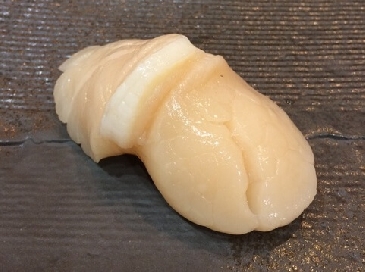
Japanese scallop (Hotate)
【Nigiri sushi: Kai】
What is Hotate?
Hotate is a Japanese word that means scallop. Hotate lives in the sandy floors of shallow sea waters and prefers regions with water temperature from 5 to 19℃, which means they are found from the Sanriku coast northward. The Sanriku coast is located in Japan’s Tohoku region. There are especially high concentrations along the Hokkaido and Aomori coastlines. For a long time, Japan boasted the highest production of scallops in the world, but China started scallop farming in the 1980s. China’s production has surpassed Japan’s and is now the highest in the world, but they are producing Azumanishiki and Atlantic bay scallops, which are different species and a size smaller than Japanese scallops.
Hotate (Scallops) is rich in protein, fat, calcium, vitamins, iron, phosphorus, etc. The main component of the adductor muscle is protein, and it has the highest protein content of any Japanese shellfish. It doesn’t have a strong kick and has a flavor that everyone loves that comes from glutamic acid (an amino acid), glycine, alanine, arginine, etc. The adductor muscle also has a high content of glycogen from Spring to Summer, so its umami increases. It also contains taurine, which facilitates eye and brain development and reduces cholesterol.
What does Hotate (Common scallop) nigiri sushi taste like?
The part of the scallop used as a sushi topping is the adductor muscle. The main sources are divided into two categories: those raised using the ear-hanging method in Funka Bay and Mutsu Bay, and wild scallops caught along the coast of the Sea of Okhotsk.
Wild scallops grow in the cold northern seas, battered by rough waves, resulting in firm flesh with a strong sweetness and delicate tenderness. On the other hand, farmed scallops tend to have adductor muscles and shells that are slightly browner than those of wild scallops.
Scallops have two peak seasons each year. Early summer is when the adductor muscles grow the thickest, and their sweetness is most pronounced. In winter, the flesh becomes even firmer, and the enlarged ovaries developed before spawning accumulate rich umami, offering a distinct taste experience.
Larger scallops are generally considered to have better flavor, and in nigiri sushi, the thick adductor muscle is often sliced open horizontally. The tender flesh blends naturally with the acidity of the vinegared rice, creating a smooth and refined texture. It also pairs well with citrus fruits and is sometimes served with lemon juice.
In Edomae sushi, scallops are not only served raw but are sometimes prepared as “simmered scallops” (ni-hotate), lightly simmered in a mixture of soy sauce, mirin, and sugar. A technique is also used in which the scallop is lightly crushed before being shaped into nigiri, allowing it to blend better with the sushi rice. While the sweetness of scallops is pronounced when raw, cooking intensifies their umami, and the harmony with the vinegared rice creates an even deeper flavor.
Also called Giant Ezo-scallop or Frill or Fan-shell or Japanese scallop.
【Trivia】
Scallops can be eaten raw, but hamaguri clam is not eaten raw. They must be cooked before eating. Because Hamaguri meat contains an aneurinase that breaks down vitamin B1. When aneurinase enters the body, it breaks down the vitamin B1 in the intestines, which can lead to B1 deficiency. If the clam is cooked, the enzyme is inactivated, so it is safe to eat.
【Substitute fish】
Japanese baking scallop: Pecten albicans (Schröter, 1802)
Atlantic bay scallop: Argopecten irradians irradians (Lamarck, 1819)
Azumapecten farreri nipponensis Kuroda, 1932
【Related contents】
What is Saxitoxin?
Nori (Dried laver seaweed)
List of Shellfish (Kai)
(Revision date: May 28, 2025)
Main production area
Hokkaido Aomori Miyagi
Famous production area
Season
Winter (Nemuro Strait)・Early summer (Mutsu Bay)